CMSI China Maritime Reports
China Maritime Reports are short papers exploring topics of current military maritime interest, published at the direction of the CMSI Director.
-
China Maritime Report No. 8: Winning Friends and Influencing People: Naval Diplomacy with Chinese Characteristics
Timothy R. Heath
In recent years, Chinese leaders have called on the People’s Liberation Army Navy (PLAN) to carry out tasks related to naval diplomacy beyond maritime East Asia, in the “far seas.” Designed to directly support broader strategic and foreign policy objectives, the PLAN participates in a range of overtly political naval diplomatic activities, both ashore and at sea, from senior leader engagements to joint exercises with foreign navies. These activities have involved a catalogue of platforms, from surface combatants to hospital ships, and included Chinese naval personnel of all ranks. To date, these acts of naval diplomacy have been generally peaceful and cooperative in nature, owing primarily to the service’s limited power projection capabilities and China’s focus on more pressing security matters closer to home. However, in the future a more blue-water capable PLAN could serve more overtly coercive functions to defend and advance China’s rapidly growing overseas interests when operating abroad.
-
China Maritime Report No. 7: Gwadar: China's Potential Strategic Strongpoint in Pakistan
Isaac B. Kardon, Conor M. Kennedy, and Peter A. Dutton
This China Maritime Report on Gwadar is the second in a series of case studies on China’s Indian Ocean “strategic strongpoints” (战略支点). People’s Republic of China (PRC) officials, military officers, and civilian analysts use the strategic strongpoint concept to describe certain strategically valuable foreign ports with terminals and commercial zones owned and operated by Chinese firms.
-
China Maritime Report No. 6: Djibouti: China's First Overseas Strategic Strongpoint
Peter A. Dutton, Isaac B. Kardon, and Conor M. Kennedy
This China Maritime Report on Djibouti is the first in a series of case studies on China’s “overseas strategic strongpoints” (海外战略支点). The strategic strongpoint concept has no formal definition, but is used by People’s Republic of China (PRC) officials and analysts to describe foreign ports with special strategic and economic value that host terminals and commercial zones operated by Chinese firms.
-
China Maritime Report No. 5: China's Dreadnought? The PLA Navy's Type 055 Cruiser and Its Implications for the Future Maritime Security Environment
Daniel Caldwell, Joseph Freda, and Lyle J. Goldstein
China’s naval modernization, a process that has been underway in earnest for three decades, is now hitting its stride. The advent of the Type 055 cruiser firmly places the PLAN among the world’s very top naval services. This study, which draws upon a unique set of Chinese-language writings, offers the first comprehensive look at this new, large surface combatant. It reveals a ship that has a stealthy design, along with a potent and seemingly well-integrated sensor suite. With 112 VLS cells, moreover, China’s new cruiser represents a large magazine capacity increase over legacy surface combatants. Its lethality might also be augmented as new, cutting edge weaponry could later be added to the accommodating design. This vessel, therefore, provides very substantial naval capability to escort Chinese carrier groups, protect Beijing’s long sea lanes, and take Chinese naval diplomacy to an entirely new and daunting level. Even more significant perhaps, the Type 055 will markedly expand the range and firepower of the PLAN and this could substantially impact myriad potential conflict scenarios, from the Indian Ocean to the Korean Peninsula and many in between. This study of Type 055 development, moreover, does yield evidence that Chinese naval strategists are acutely aware of major dilemmas confronting the U.S. Navy surface fleet.
-
China Maritime Report No. 4: Civil Transport in PLA Power Projection
Conor M. Kennedy
The People’s Liberation Army (PLA) has ambitious goals for its power projection capabilities. Aside from preparing for the possibility of using force to resolve Beijing’s territorial claims in East Asia, it is also charged with protecting China’s expanding “overseas interests.” These national objectives require the PLA to be able to project significant combat power beyond China’s borders. To meet these needs, the PLA is building organic logistics support capabilities such as large naval auxiliaries and transport aircraft. But it is also turning to civilian enterprises to supply its transportation needs.
-
China Maritime Report No. 3: China’s Distant-Ocean Survey Activities: Implications for U.S. National Security
Ryan D. Martinson and Peter A. Dutton
Today, the People’s Republic of China (PRC) is investing in marine scientific research on a massive scale. This investment supports an oceanographic research agenda that is increasingly global in scope. One key indicator of this trend is the expanding operations of China’s oceanographic research fleet. On any given day, 5-10 Chinese “scientific research vessels” (科学考查船) may be found operating beyond Chinese jurisdictional waters, in strategically-important areas of the Indo-Pacific. Overshadowed by the dramatic growth in China’s naval footprint, their presence largely goes unnoticed. Yet the activities of these ships and the scientists and engineers they embark have major implications for U.S. national security.
This report explores some of these implications. It seeks to answer basic questions about the out-of-area—or “distant-ocean” (远洋)—operations of China’s oceanographic research fleet. Who is organizing and conducting these operations? Where are they taking place? What do they entail? What are the national drivers animating investment in these activities?
-
China Maritime Report No. 2: The Arming of China’s Maritime Frontier
Ryan D. Martinson
China’s expansion in maritime East Asia has relied heavily on non-naval elements of sea power, above all white-hulled constabulary forces. This reflects a strategic decision. Coast guard vessels operating on the basis of routine administration and backed up by a powerful military can achieve many of China’s objectives without risking an armed clash, sullying China’s reputation, or provoking military intervention from outside powers.
Among China’s many maritime agencies, two organizations particularly fit this bill: China Marine Surveillance (CMS) and China Fisheries Law Enforcement (FLE). With fleets comprising unarmed or lightly armed cutters crewed by civilian administrators, CMS and FLE could vigorously pursue China’s maritime claims while largely avoiding the costs and dangers associated with classic “gunboat diplomacy.”
-
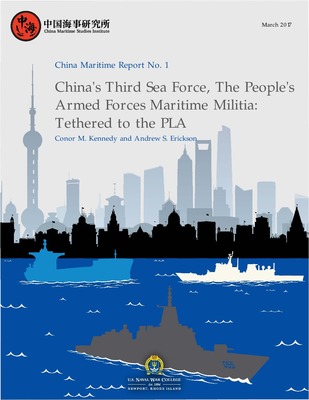
China Maritime Report No. 1: China’s Third Sea Force, The People’s Armed Forces Maritime Militia: Tethered to the PLA
Conor M. Kennedy and Andrew S. Erickson
Amid growing awareness that China’s Maritime Militia acts as a Third Sea Force which has been involved in international sea incidents, it is necessary for decision-makers who may face such contingencies to understand the Maritime Militia’s role in China’s armed forces. Chinese-language open sources reveal a tremendous amount about Maritime Militia activities, both in coordination with and independent of the People’s Liberation Army (PLA). Using well-documented evidence from the authors’ extensive open source research, this report seeks to clarify the Maritime Militia’s exact identity, organization, and connection to the PLA as a reserve force that plays a parallel and supporting role to the PLA. Despite being a separate component of China’s People’s Armed Forces (PAF), the militia are organized and commanded directly by the PLA’s local military commands. The militia’s status as a separate non-PLA force whose units act as “helpers of the PLA” (解放军的 助手) is further reflected in China’s practice of carrying out “joint military, law enforcement, and civilian [Navy-Maritime Law Enforcement-Maritime Militia] defense” (军警民联防). To more accurately capture the identity of the Maritime Militia, the authors propose referring to these irregular forces as the “People’s Armed Forces Maritime Militia” (PAFMM).