CMSI Translations are translations of articles pulled from Chinese military maritime publications.
-
CMSI Translations #12: Strengthen Command Capabilities to Win Future Naval Battles
Wei Gong
Chairman Xi Jinping's emphasis on "strengthening command capabilities" has indicated the direction of effort and injected a powerful impetus for all-level commanders to fulfill their main responsibilities, meet challenges from adversaries, and win future naval battles. Observing the emerging patterns of new combat capabilities in new domains and reviewing the year's work to prepare for war, in the case of new combat platforms, commanders’ ability to strengthen their command capabilities is reflected in their dual responsibility for both the platform and the system. This includes the responsibilities to scientifically coordinate maneuver and firepower to address threats from individual ships and aircraft, to fulfill responsibilities for domain specific operational tasks, and to serve as a system hub for new combat power and shaping advantageous combat postures for the formations and systems. These responsibilities expand the meaning of command capabilities and place higher demands on commanders.
-
CMSI Translations #11: Mid-Life Overhaul and Upgrade of the Type 052C Guided Missile Destroyer
Ju Lang
The construction of the Type 052C guided missile destroyer took a long time, and it was experimental in the sense of "taking small steps for rapid progress" (xiao bu kuai pao). In fact, it was also the engineering prototype of the standard fleet destroyer Type 052D. The first and second Type 052C ships were launched in April and October 2003, respectively. They were the most advanced guided missile destroyers of the PLAN at that time, but the subsequent four ships of the same type were launched in October 2010, July 2011, and January and July 2012, respectively.
-
CMSI Translations #10: Transformation, How Significant is the Role of an Airfield Station?
Gao Hongwei, Shen Hongquan, and Zhang Tong
In recent years, with the expansion of mission tasks, multiple services and multiple aircraft types organizing training at the same Southern Theater Command Navy aviation airfield station has gradually become the norm. In the face of increasingly heavy combat training support tasks, they closely monitor powerful enem(ies), accelerate transformation and construction, and have achieved a historic leap from single aircraft-type support to multiple aircraft-types support, from small flying periods of short-term deployed training support to large flying periods of regularized deployed training support, and from daytime simple meteorological conditions support to allweather support, with core support capabilities being comprehensively enhanced.
-
CMSI Translations #9: Mine Countermeasure Operations in a Cross-Strait Island Landing Campaign
Tian Ying
Sea mines are a type of cheap, easy to produce naval weapon that can be used both offensively and defensively. They have played a huge tactical role and even a strategic role in many wars from ancient times to the present day. Sea mines have low production costs, and they are powerful, simple to use, easy to emplace, and difficult to remove. They are characterized by the long-term threat they can pose to ports and shipping lanes. Countering sea mines is relatively difficult and requires the expenditure of rather large resources by the side conducting mine countermeasure operations.
-
CMSI Translations #8: U.S.-Philippine Military Cooperation in the South China Sea: Challenges and Responses
Zhang Yilong
With the new generation of Philippine government taking office, U.S.-Philippines relations have rapidly warmed, and the depth and breadth of their military cooperation have increased. This has brought new challenges and threats to China’s national security. How to deal with these challenges will be a difficult problem before us.
-
CMSI Translations #7: Guarantee of Strategic Security: Expert Discusses China’s Strategic Nuclear Submarines Achieving Continuous Duty
Chi Guocang
In April of this year, the U.S. Department of Defense released a China military power report, which stated that the Chinese Navy currently has at least six Type 094 ballistic missile nuclear submarines, and has the capability for at least one of them to be on continuous readiness duty. It also said that this is the first time it has been possible for the Chinese Navy to permanently maintain at least one strategic missile nuclear submarine at sea to perform strategic duty tasks. So, what is “continuous readiness duty” (quatianhou zhanbei zhiban), how can it be achieved, and why did the Chinese Navy only just now acquire this capability? With these questions in mind, we interviewed Professor Chi Guocang (迟国仓) of the PLAN Submarine Academy and asked him to give us a detailed explanation.
-
CMSI Translations #6: Building a World-Class Navy in a Comprehensive Way: It's Logic in Theory, History, and Practice
Liu Lijiao and Jia Benjia
"Building a world-class navy in a comprehensive way" is a vivid embodiment and concrete manifestation of the Chinese Communist Party's goal of building a strong military in the new era, as expressed in the domain of naval building and operations. This is both a major theoretical issue and practical issue. When it comes to realizing the centenary military building goal and creating a new situation via naval modernization, this will have major and far-reaching importance. [We must] deeply understand its internal logic in theory, history, and practice to accelerate naval transformation and development, and elevate at-dea deterrence and combat capabilities.
-
CMSI Translations #5: Strengthen National Defense Mobilization and Reserve Force Construction
Yu Yunxian and Zhang Pengxuan
The report of the 20th National Congress of the Communist Party proposed "strengthening national defense mobilization and reserve force construction." In the face of the Era's requirements for strengthening the country and the military, the serious situation of national security, and the real existence of the risk of war, we must place the construction of national defense mobilization and reserve forces in a more important strategic position, and strive to promote the high-quality development of national defense mobilization and reserve force construction from a new starting point.
-
CMSI Translations #4: Charging into Battle—A Deeply Entwined Network: A Profile of Wang Chengfei, Director of a Research Office at the Naval Research Academy
Wang Kun, Ye Zhong, and Zhou Huaiping
Wang Chengfei, Director of a research office and senior engineer at the Naval Research Academy, has presided over the initiation and evaluation of several major comprehensive information system equipment projects. He has compiled a development guide and technical requirements for Navy unmanned intelligent equipment technology systems, filled many specifications gaps, won a second- class Military Science and Technology Progress Award, obtained eight national defense patents, and was once awarded a third-class citation.
-
CMSI Translations #3: Discussion on the Requirements and Methods of Intelligent Decision-Making in Torpedo Attacks by Unmanned Underwater Vehicles
Ma Liang, Guo Liqiang, Zhang Hui, Yang Jing, and Liu Jian
Autonomous technology in unmanned equipment is currently the most dynamic frontier technology field, and improving the level of intelligent decision-making is an inevitable trend in the development of unmanned underwater vehicles (UUVs). Torpedo attack decision-making is an important part of attack-type UUVs' attack missions, and it is also the basis and premise for forming self-organizing cross-domain collaboration, autonomous cluster confrontation, and other operational capabilities. Beginning by sorting through the characteristics of operational use and typical mission styles, this article summarizes the advantages and disadvantages of UUVs compared to manned platforms, analyzes the decision-making content different from traditional torpedo attacks, expounds on the key issues that need to be resolved in implementing decisionmaking functions, and, based on the development status of machine learning technology, proposes an intelligent decision-making method suitable for solving problems such as large uncertainty in observation data, difficulty in guaranteeing real-time attack decision-making, and weak model perception interaction capabilities. This research can serve as a reference for future research in unmanned equipment development and intelligent decision-making fields.
-
CMSI Translations #2: Dominating the Battlefield—The Advantages of Unmanned Intelligent Combat Forces
Zhao Xiangang and Su Yanqin
In his report to the 20th National Congress of the Communist Party of China, Xi Jinping emphasized the need to accelerate the development of unmanned intelligent combat forces. Looking at the practice of local wars in recent years, unmanned combat forces as represented by drones have become an important part of the joint operational force system, playing an increasingly prominent role as an effectiveness multiplier. Especially with the advent of artificial intelligence technology and its rapid development and widespread use in the military field, unmanned systems are becoming more intelligent and autonomous, and unmanned intelligent operations are showing advantages and effectiveness that are different from those in the past.
-
CMSI Translations #1: The “Cans” and “Cannots” of the Military Application of Artificial intelligence
Zhang Long
The application of artificial intelligence (AI) in the military field is an important force for promoting improvements in military technology and progress in the revolution of military affairs and is a key driver changing operational patterns and disrupting the form of war. In the upsurge of military applications of AI, we must think carefully about future decisions, deeply understand the technological hub (jishu shuniu) role of AI, dialectically view the functional boundaries of military applications of AI, and accurately grasp what AI "can" and "cannot" do. We must oppose both contemptuous and omnipotent theories of AI military application, comprehensively and objectively clarify what AI "can" and "cannot" do in military applications, and strive to seize the opportunity, win the initiative, develop systematically, and make breakthroughs in the military application of AI.
-
CMSI Archive Translation: An Analysis of China’s Maritime Development Strategy and Trends in Ship Development
Xie Wei and Lu Chao
The authors analyze how strategic goals, such as the need to “break through” island chain limitations, dictate hardware development trends and the requirement for integrated far-seas support systems
-
CMSI Archive Translation: An Analysis of the Necessity and Feasibility of Strengthening Construction of a Far Seas Navy
Fang Xiaozhi
Fang Xiaozhi analyzes the necessity and feasibility of building a far-seas navy to protect China's expanding global economic interests and secure vital sea lines of communication (SLOCs) and global maritime choke points
-
CMSI Archive Translation: A Study of Maritime Strategic Thoughts of Mao Zedong, Deng Xiaoping, and Jiang Zemin
Liu Zhongmin
This article examines the foundational maritime thoughts of China's past leaders, illustrating a continuous strategic evolution that progressively expanded the navy's sphere of operations from "coastal defense" toward "near-seas defense"
-
CMSI Archive Translation: Excerpts From Introduction to Warship Technology and Design, Second Edition
Zhao Kaiwen and Ma Yunyi
This compilation explores the industrial "how" of naval development, highlighting the shift toward modular and digitized construction and "mass customization" to produce specialized vessels with greater speed and agility
-
CMSI Archive Translation: On the Navy’s Strategic Positioning in the New Era
Shi Cangyong and Chen Yan
This article outlines the navy's refined strategic positioning in the "New Era," specifically its mission to achieve “regional sea control and transoceanic projection” to safeguard core national interests within and beyond the first island chain
-
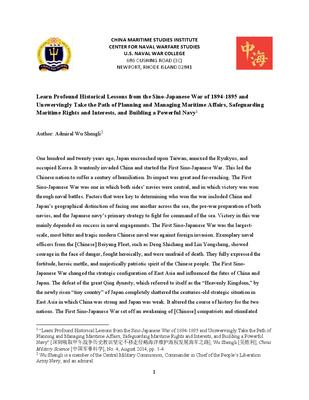
CMSI Archive Translation: Planning and Managing Maritime Affairs, Safeguarding Maritime Rights and Interests, and Building a Powerful Navy
Wu Shengli
Former PLAN Commander Admiral Wu Shengli reflects on the First Sino-Japanese War as a catastrophic failure of "ocean consciousness," arguing that constructing a powerful navy commensurate with a great power is an indispensable requirement for national rejuvenation
-
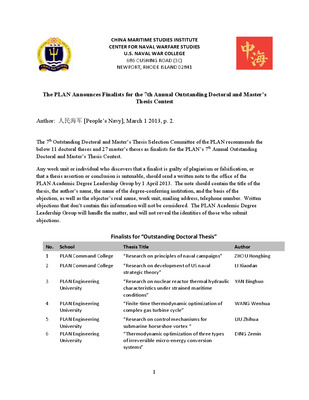
CMSI Archive Translation: PLAN Research Priorities: Outstanding Doctoral and Master’s Thesis Finalists
People's Navy
This report identifies the PLAN’s specific research priorities—ranging from nuclear reactor characteristics to the operational use of nuclear submarines in carrier strike groups—through its outstanding academic thesis finalists
-
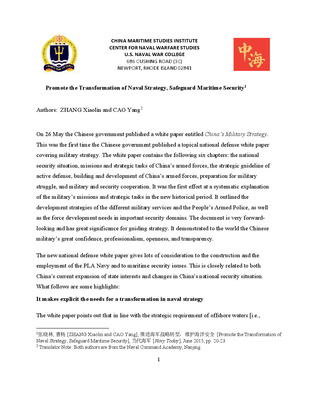
CMSI Archive Translation: Promote the Transformation of Naval Strategy, Safeguard Maritime Security
Zhang Xiaolin and Cao Yang
This article details the 2015 Defense White Paper mandate for the navy to shift from "near seas defense" to a dual-layered strategy that integrates "near seas defense" with "far seas protection"
-
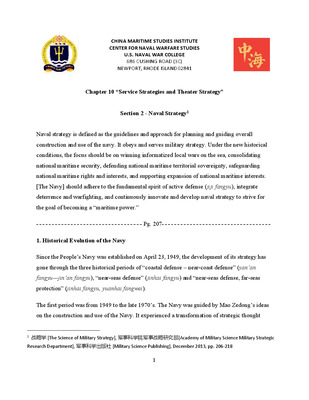
CMSI Archive Translation: Science of Military Strategy: Naval Strategy
AMS (Academy of Military Science)
This authoritative text provides a comprehensive timeline of PLAN strategy, formalizing the expansion from "near-seas defense" to "near-seas defense, far-seas protection" and explicitly defining the navy's modern peacetime and wartime missions
-
CMSI Archive Translation: The Complexity of the Maritime Military Struggle Calls for a Powerful Navy
Li Daguang and Ma Zheng
The authors discuss how the increasing complexity of maritime military struggle and the urgent requirement to protect overseas citizens and property drive the need for a modern, powerful navy capable of winning informationalized local wars
-
CMSI Archive Translation: Though the Path is Long, We Will Get There if We Walk, Though the Task is Difficult, We will Succeed If We Try
Xing Wenge
Xing Wenge emphasizes closing the capability gap with the U.S. Navy through “top-down design” and the development of network-centric equipment driven by real-combat requirements and systems engineering
-
CMSI Archive Translation: Sharpening Their Sword, On Course for Victory: An Account of the Armament Department of the East Sea Fleet Leveraging the Advantages of the New System in Order to Improve Equipment Support Abilities
Chen Xiong, Chi Zumin, Liu Yuexiang, Wang Chunfeng, Dai Zongfeng, and Yin Fei
This article details reforms within the East Sea Fleet’s Armament Department to adapt to expanding naval missions. It highlights a transition from pure hardware maintenance to a "soft and hard" support model that integrates technical repairs with submariner training and psychological confidence in their equipment. The piece also explores the benefits of a "factory conglomerate" model for more efficient repairs and the normalization of civil-military integration for specialized technical support.
-
CMSI Archive Translation: Analysis of Problems with Warship Damage Control Plans and Methods for Preparing Damage Control Plans
Jian Huajun and Zhu Haishi
This source provides a technical framework for preparing scientific and rational damage control plans aimed at maintaining a warship's "vitality". It critiques existing plans for being "divorced from reality" and calls for plans based on quantified risk assessments, such as precise flooding rates and fire extinguishing data. The authors advocate for a "planning–drilling–revising" cycle to ensure plans are simple, realistic, and streamlined for actual combat.