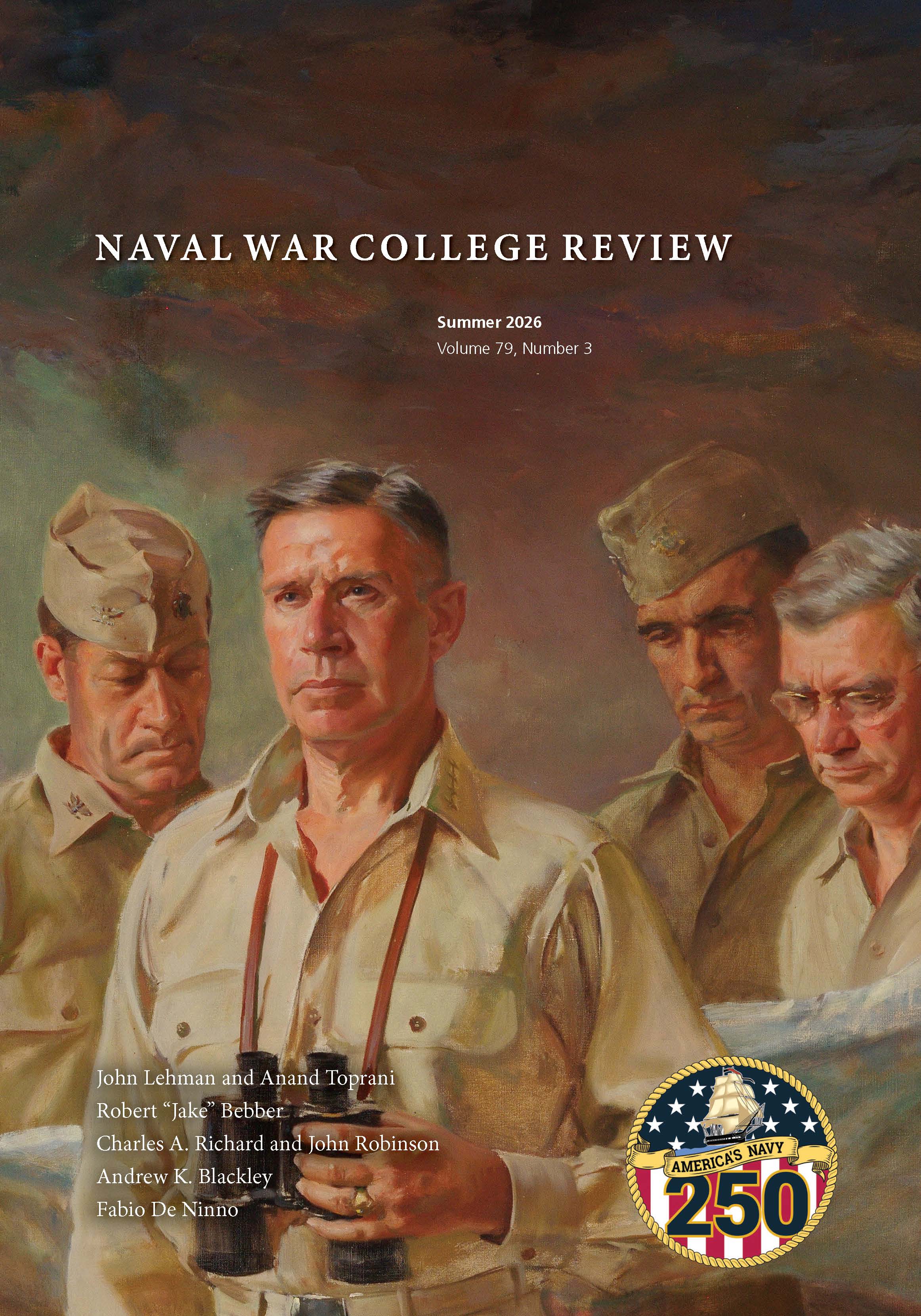
Naval War College Review
Volume 79, Number 3 (2026) Summer 2026
Engaging with the past while forging the future strategies of naval operations is a priority of the Naval War College Review, and this issue encapsulates that vision well. Starting with our lead article, "The Acquisition Lessons of the 1980s and Their Continuing Relevance" by John Lehman and Anand Toprani, the future of maritime strategy is examined through the lens of lessons learned from the Cold War. In both Robert "Jake” Bebber's article "The Cognitive Dimension of Mobilization: Reconsidering American War Preparation in an Age of Persistent Cognitive Warfare" and Charles A. Richard and John Robinson's "Narrowing Seas: The Littoral Strike Complex and the Future of Naval Warfare," the future of naval operations is investigated through the lenses of emerging forms of cognitive warfare and the use of drones by Ukraine, respectively. Turning toward a more historical lens, “'A True Sailor-Statesman': The Ethical Quandary of Ambassador Raymond A. Spruance in the Philippines" by Andrew K. Blackley reexamines claims of ethical misconduct during Spruance's ambassadorship. Fabio De Ninno's "Fighting without Mastery: Italian Naval Strategy and the Defeat of the Regia Marina in the Mediterranean, 1940–1943" looks at the various reasons the Italian navy failed to control critical sea-lanes during World War II. Finally, Robert C. Rubel revisits concepts of parallelism in warfare strategies of the past in this issue's Research & Debate, titled "Forms of Military Strategy: Historical Parallels between the American Confederacy and Imperial Japan, and a Way Forward.”
Full Issue
Summer 2026 Full Issue
The U.S. Naval War College
From the Editors
From the Editors
Sam J. Tangredi Editor-in-Chief
President's Forum
President's Forum
Darryl "D-Day" Walker Rear Admiral, U.S. Navy, President, Naval War College
Articles
The Acquisition Lessons of the 1980s and Their Continuing Relevance
John Lehman and Anand Toprani
The Cognitive Dimension of Mobilization—Reconsidering American War Preparation in an Age of Persistent Cognitive Warfare
Robert "Jake" Bebber
Narrowing Seas—The Littoral Strike Complex and the Future of Naval Warfare
Charles A. Richard and John Robinson
“A True Sailor-Statesman”—The Ethical Quandary of Ambassador Raymond A. Spruance in the Philippines
Andrew K. Blackley
Fighting without Mastery—Italian Naval Strategy and the Defeat of the Regia Marina in the Mediterranean, 1940–1943
Fabio De Ninno
Book Reviews
Review Essay—A Wake for Objective Control—"The State and the Soldier: A History of Civil-Military Relations in the United States"
Frank Hoffman and Kori Schake
The Greatest Naval War Ever Fought
Harold Ambler and Vincent P. O’Hara
Left for Dead: Shipwreck, Treachery, and Survival at the Edge of the World
Michael Romero and Eric Jay Dolin
Rome: Strategy of Empire
Charles Nathan Swope and James Lacey
Sustaining the Carrier War: The Deployment of U.S. Naval Air Power to the Pacific
Viktor M. Stoll and Stan Fisher