

Files
Download Full Text (535 KB)
Description
CMSI’s Perspectives and Key Takeaways:
- The incoming William Lai/Bi-khim Hsiao administration almost certainly intends to continue to execute and deepen President Tsai’s defense reforms. Lai has also stated his support for the implementation of an Indo-Pacific Strategy concept.
- Lai has an opportunity to leverage the national security experience of President Tsai’s outgoing advisors, who may potentially help his administration calibrate Taiwan’s responses to People’s Liberation Army (PLA) military provocations in and around the Taiwan Strait.
- The Lai administration likely would prove receptive to U.S. and partner overtures that contribute to Taiwan’s ability to strengthen its maritime domain awareness and security; enhance maritime law enforcement and search and rescue capabilities; conduct maritime patrols; and improve information sharing.
- Lai intends to maintain the cross-Strait status quo, and has stated that he is willing to conduct dialogue with the People’s Republic of China (PRC) on the basis of mutual respect and equality.
- Lai almost certainly will seek to continue President Tsai Ing-wen’s policy of diversifying Taiwan’s economy and expanding sustainable trade partnerships with democratic nations. He has stated that overdependence on the PRC leaves Taiwan vulnerable to economic coercion, and thus opposes pursuing further economic agreements with China under the Economic Cooperation Framework Agreement (ECFA) or a potential Cross-Strait Trade in Services Agreement (CSTSA).
Publication Date
1-2024
Publisher
China Maritime Studies Institute, U.S Naval War College
City
Newport, Rhode Island
Keywords
China, PRC, China Maritime Studies Institute, CMSI, People’s Liberation Army, People’s Liberation Army Navy, PLAN, Taiwan, Lai, Hsiao
Recommended Citation
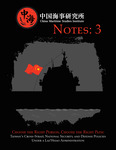
Famularo, Julia M., "CMSI Note #3: “Choose the Right Person, Choose the Right Path”: Taiwan’s Cross-Strait, National Security, and Defense Policies Under a Lai/Hsiao Administration" (2024). CMSI Notes. 3.
https://digital-commons.usnwc.edu/cmsi-notes/3
Accessibility Request
Some items in this repository were created or digitized prior to implementation of the accessibility standards under the Rehabilitation Act of 1973 and are preserved in their original, unmodified state for research, reference, or historical recordkeeping. In accordance with the ADA Title II Final Rule, the College provides accessible versions of archival materials upon request. To request a version of a file or resource, please submit an Accessible File Request Form.


