

Naval War College Review
Volume 79, Number 4 (2026) Autumn 2026
The keys to our past help illuminate the future of the maritime domain in this issue. Starting with the lead article, "Perception Management: An Overlooked and Enduring Element of the 1980s Maritime Strategy," Anand Toprani sheds light on Cold War lessons through a newly public collection of William Manthorpe's archival materials. Michael Kidd, Giana Farry, Violet G. Frost, Liam Kiley, Aakash Palathra, and Moe Abdelsalam explore the widespread ramifications and chains of risks owing to choke-point disruptions in "Interrelated Risk of the Maritime Choke-Point Network." Historical patterns and practitioner experience are presented as a possible solution to blockades in naval innovation in David H. Lewis's "Creating the Foundry: Organizational Learning and Technology Innovation Leadership in the United States Navy." Charles Edward Gehrke answers the question of war gaming's purpose in "What War Games Actually Teach: Threat Recognition, Not Prediction." Attacks on submarine cables are revealed to be a much more prevalent occurrence than it would first appear in Jonathan Winkler's "A History of State Attacks on Submarine Cables." Dan-Dragoș Sichigea's "The Other Dunkirk: German-Romanian Preparations for the Evacuation of Crimea (1943–1944)" examines the eighty-plus-year-old event with an eye toward recent conflict in the region. Matthew Ikenoyama presents a possible new paradigm for managing moral injury in "Moral Injury Is a Readiness Problem: The Case for a Chaplain-Led, Peer-Intervention Model." Finally, "'Long before the Enemy Is Sighted': Frank Marble, USN," written by Carlos R. Rivera, paints a picture of a forgotten figure in naval history.
Full Issue
Autumn 2026 Full Issue
The U.S. Naval War College
From the Editors
From the Editors
Sam J. Tangredi Editor-in-Chief
President's Forum
President's Forum
Darryl "D-Day" Walker Rear Admiral, U.S. Navy, President, Naval War College
Articles
Perception Management—An Overlooked and Enduring Element of the 1980s Maritime Strategy
Anand Toprani and William Manthorpe
Interrelated Risk of the Maritime Choke-Point Network
Michael Kidd, Giana Farry, Violet G. Frost, Liam Kiley, Aakash Palathra, and Moe Abdelsalam
Creating the Foundry—Organizational Learning and Technology Innovation Leadership in the United States Navy
David H. Lewis
What War Games Actually Teach—Threat Recognition, Not Prediction
Charles Edward Gehrke
A History of State Attacks on Submarine Cables
Jonathan Winkler
The Other Dunkirk—German-Romanian Preparations for the Evacuation of Crimea (1943–1944)
Dan-Dragoș Sichigea
Research & Debate—Moral Injury Is a Readiness Problem: The Case for a Chaplain-Led, Peer-Intervention Model
Matthew Ikenoyama U.S. Navy
In My View
Vincent P. O’Hara and Thomas Hone
Special Feature—Twenty Years of the China Maritime Studies Institute
Andrew S. Erickson
Book Reviews
Eugene Ely: Pioneer of Naval Aviation
Richard Norton and John H. Zobel
China’s Spies: Beijing’s Espionage Offensive
Andrew G. Wilson and Nigel West
Saving MacArthur: The Story of America’s Most Daring Naval Rescue, and of the Men It Left Behind
Edmund B. Hernandez and Rudy Tomedi
Credits
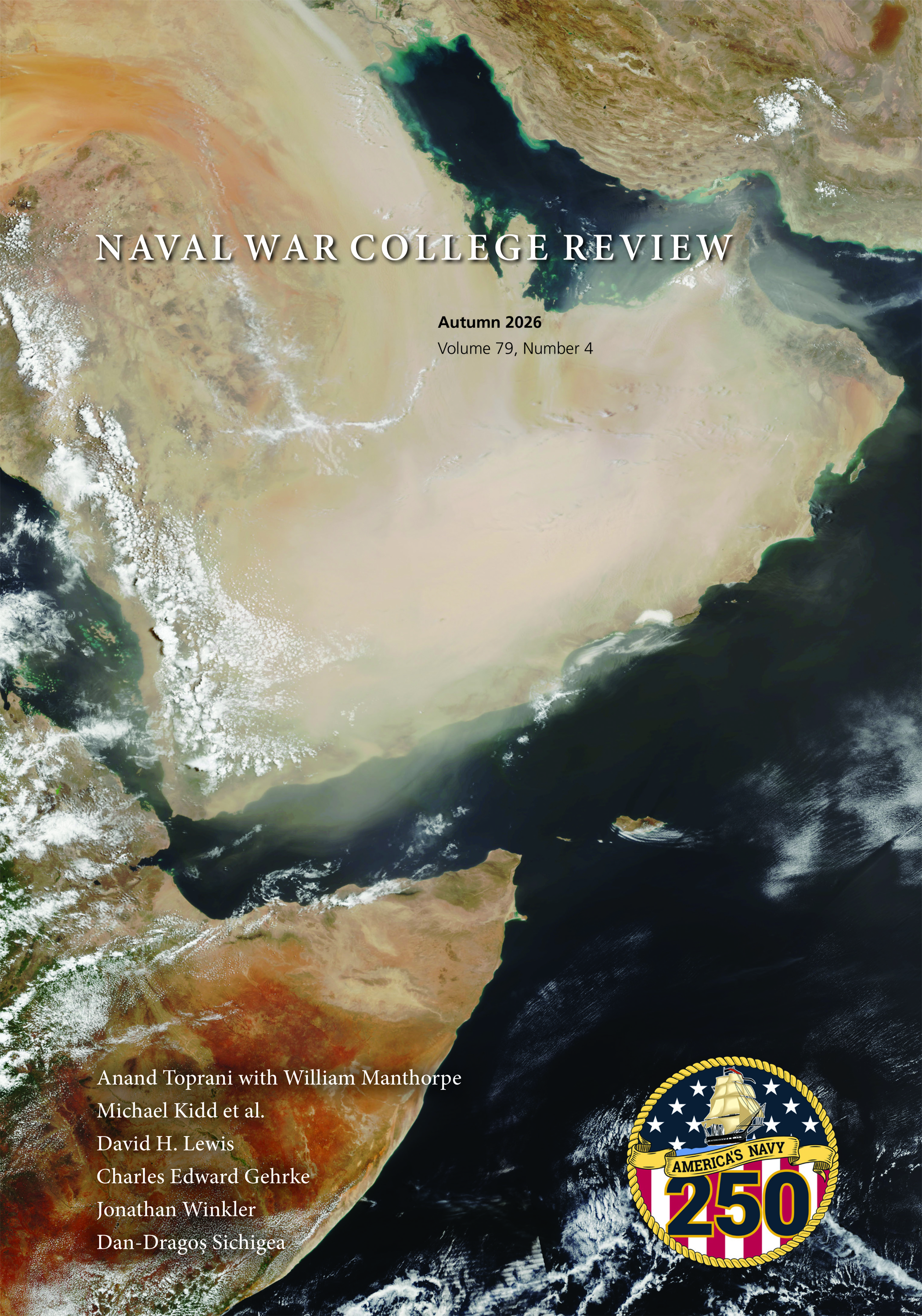
This satellite imaging shows the shamal—a hot and dry, low-level northwesterly wind—blowing across the Arabian Peninsula and both the Strait of Hormuz and the Bab el Mandeb. These two straits represent critical entities in the global maritime choke-point system. In this issue, Michael Kidd, Giana Farry, Violet G. Frost, Liam Kiley, Aakash Palathra, and Moe Abdelsalam explore the widespread ramifications on the economy and the military risks associated with these and other waterways in “Interrelated Risk of the Maritime Choke-Point Network.” Source: NASA.