Newport Papers
Newport Papers are extended research projects that the Director, the Dean of Naval Warfare Studies, and the President of the Naval War College consider to be of particular interest to policy makers, scholars, and analysts. These book-length monographs cover a variety of subjects, but ideally relate to contemporary operational or strategic concerns in the realm of maritime security. Printed copies of Newport Papers are distributed to a list of approximately 300 senior commanders and staff members.
-
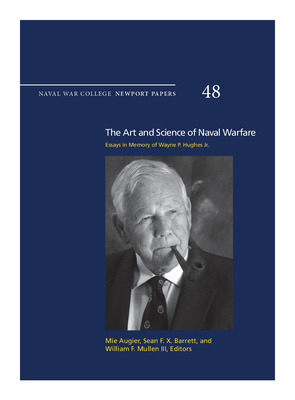
The Art and Science of Naval Warfare: Essays in Memory of Wayne P. Hughes Jr.
Mie Augier, Sean F. X. Barrett, and William F. Mullen III
Retired Navy captain Wayne P. Hughes left an indelible mark on the U.S. Navy after a lifetime of service. The author of Fleet Tactics was outspoken in his determination to better the service to which he dedicated his life, throughout his Navy career and carrying through to his time teaching at the Naval Postgraduate School in Monterey, California. Following his passing on 3 December 2019 at the age of eighty-nine, Hughes's colleagues, students, and friends gathered virtually in June 2021—on what would have been his ninetieth birthday—to discuss his career, fleet tactics, and the lasting impact of his work. Collected in this volume is a series of articles born out of that gathering.
-
Analogous Response Redux: Vladimir Putin’s Aspirations for Altering the Maritime Balance
Jerome J. Burke
Analogous Response was a term of analytical shorthand that American strategists and intelligence analysts developed in late 1983 and early 1984. The term characterized in two words a Soviet maritime strategy of deploying off the U.S. coast submarines armed with nuclear SLCMs. By making that deployment, the Soviet leadership could establish an endo-atmospheric nuclear threat to the continental United States (CONUS) that Marshal Nikolay V. Ogarkov, chief of the General Staff of the USSR, described as follows: “The Soviet systems to be deployed in the oceans and seas and relevant to the territory of the United States itself will be no less effective than American systems that are being deployed in Europe, in range, yield, accuracy, and, what is especially important, in time of flight to their targets.”
-
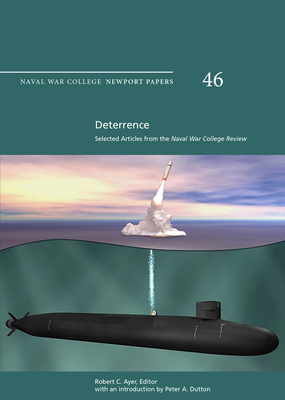
Deterrence: Selected Articles from the Naval War College Review
Robert C. Ayer, Jack Raymond, Colin S. Gray, Donald M. Snow, Edward J. Ohlert, Jerome J. Burke, George R. Lindsey, Hunter Stires, Sam Goldsmith, Jeffrey E. Kline, Wayne P. Hughes Jr., and William S. Murray
The subject of deterrence fell away from the forefront of American strategic thinking during the three decades following the fall of the Soviet Union. Our ability to deter much weaker states by denying them the ability to achieve their aims was long assumed. But today there is a new global security situation that makes it imperative for American military officers and security specialists to begin to relearn the fundamental tenets of this aspect of national security.
The purpose of this volume is to contribute to that campaign of learning by drawing on some of the excellent scholarship published in the Naval War College Review during the Cold War and the decades since. Some of the articles included here lay out a few of the fundamentals of the theories of deterrence.
-

Ten Years In: Implementing Strategic Approaches to Cyberspace
Jacquelyn G. Schneider, Emily O. Goldman, Michael Warner, Paul M. Nakasone, Chris C. Demchak, Nancy A. Norton, Joshua Rovner, Timothy D. Haugh, William R. Garvey, Erika E. Volvino, Ryan R. Lemmerman, Erica D. Borghard, Shawn W. Lonergan, Timothy J. White, Paul Stanton, Michael Tilton, Peter Dombrowski, and Nina Kollars
This book represents a look beyond theories and analogies to examine the challenges of strategy implementation. In the essays that follow, practitioners who are building cyberspace forces at-scale join scholars who study power and force in this new domain to collectively offer a unique perspective on the evolution and future of cyber strategy and operations.
-

On Wargaming
Matthew B. Caffrey Jr.
Wargames are as old as civilization—and perhaps older. In his informative and entertaining Public Broadcasting series Connections, James Burke argued that the first invention, the one that enabled all later inventions, was the plow. It allowed agriculture, and as agriculture permitted denser populations, the frequency of inventions increased, due either to “connecting” with new applications or combining with other inventions to create one that was greater than the sum of its parts.
-

Taiwan’s Offshore Islands, Pathway or Barrier?
Bruce A. Elleman
This Newport Paper will examine the role of offshore islands in twentieth-century East Asian history, in particular those islands in the Taiwan Strait that were disputed by the People’s Republic of China (PRC) and the Republic of China (ROC) during the 1950s and afterward, and how these apparently insignificant islands impacted Cold War history.
-
Navies and Soft Power
Bruce A. Elleman and S.C.M. Paine
Navies and Soft Power: Historical Case Studies of Naval Power and the Nonuse of Military Force, edited by Bruce A. Elleman and S. C. M. Paine, presents nine historical cases of the use of navies in nonmilitary missions. These studies, by established and emerging scholars in a wide variety of fields, support current U.S. Navy attempts to balance war fighting with an ever broader array of nonmilitary missions. They remind us that naval "soft power" concerns date from antiquity and that those facing the U.S. Navy have now become remarkably diverse.
-
Writing to Think
Robert C. Rubel
The purpose of this volume is to honor the work and thought of Robert C. Rubel, Captain, U.S. Navy (Ret.). Since his retirement from the Navy, Robert (a.k.a. “Barney”) Rubel has held senior positions in the Center for Naval Warfare Studies (CNWS), in the Naval War College, in Newport, Rhode Island—first as deputy dean, then as chairman of the War Gaming Department, and finally (since 2006) as dean. During this period, not only has he presided effectively over a complex (and in many ways anomalous) institution, but he has found the time to create a substantial body of published writings about naval warfare and war, or strategy generally. In the process, he has quietly established himself as one of the Navy’s most innovative and wide-ranging thinkers.
-
Commerce Raiding
Bruce A. Elleman and S.C.M. Paine
The sixteen case studies in this book reflect the extraordinary diversity of experience of navies attempting to carry out, and also to eliminate, commerce raiding. Because the cases emphasize conflicts in which commerce raiding had major repercussions, they shed light on when, how, and in what manner it is most likely to be effective. The authors have been asked to examine the international context, the belligerents, the distribution of costs and benefits, the logistical requirements, enemy countermeasures, and the operational and strategic effectiveness of these campaigns.
-
Influence without Boots on the Ground
Larissa Forster
Military intervention always has been and always will be an important part of foreign policy, a tool to further national interests and influence world events. Many scholars have tried to explain the intervention behavior of states in crises, conflicts, and wars. When and why do states intervene, and what are reasons for nonintervention? What conflicts and crises are more likely to call for intervention, and why? When is intervention successful? The explanations are manifold and include political, military, economic, social, environmental, domestic, and humanitarian factors. The theoretical literature covers a gamut of realist intentions, ranging from security, power, and national interests, as guides to state action; to emphasis on international trade and economics; and to domestic politics. Some argue for explanations based on idealistic aspirations, such as democracy and human rights. Many studies focus on a mix of different reasons. From this vast field, the author has selected international crises involving any form of U.S. activity in the years 1946-2006. Within these U.S. activities, the author distinguishes between crisis response with and without naval forces, as this study intends to advance the knowledge of the use of U.S. naval forces as a response to international crises and to contribute to a better understanding of when and how the U.S. Navy is deployed.